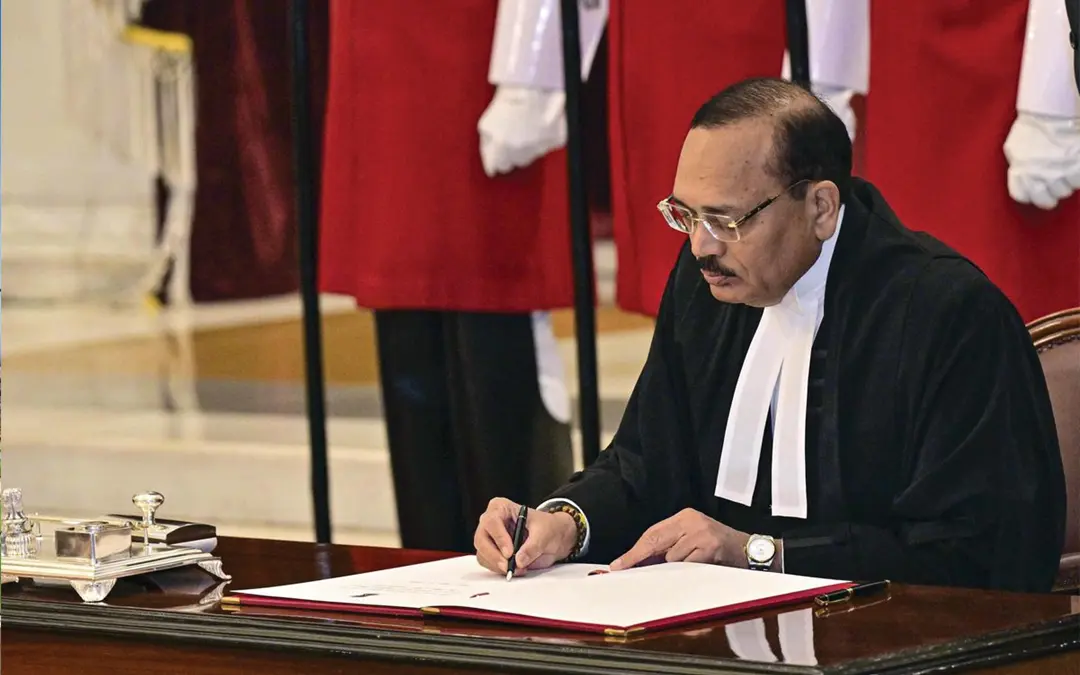
Justice Surya Kant was formally sworn in as the 53rd Chief Justice of India (CJI) yesterday, Monday, November 24, 2025, at a ceremony administered by President Droupadi Murmu at Rashtrapati Bhavan. Justice Kant, the first person from Haryana to reach the pinnacle of the Indian judiciary, will hold the office for a tenure of nearly 15 months, until February 9, 2027.
The swearing-in ceremony was marked by a large and personal guest list, including his former teachers, village elders, and friends—a testament to his humble roots in the Hisar district of Haryana.
Priorities: Arrears and Mediation
In his first statements following the appointment, the new CJI outlined his two most critical priorities for his term, focusing on systemic efficiency:
- Tackling Case Backlog: CJI Kant stated that his “first and foremost challenge is arrears of cases.” He acknowledged that the Supreme Court alone has crossed 90,000 pending cases, with the total backlog across all courts in India exceeding five crore. His strategy involves identifying core cases that are holding up thousands of related matters in lower courts, constituting more Constitution Benches to decide them quickly, and optimizing the utilization of judicial force.
- Promoting Mediation: His second top priority is to institutionalize mediation as a “game changer” for dispute resolution. He emphasized that encouraging parties, including private corporations and banks, to settle suitable cases through mediation is the most effective way to provide faster, off-court relief and significantly reduce the burden on the courts.
Landmark Rulings and Legacy
CJI Kant’s tenure as a Supreme Court judge has been marked by several significant, often politically charged, rulings:
- Article 370: He was part of the Constitution Bench that upheld the abrogation of Article 370, which removed the special status of Jammu and Kashmir.
- Sedition Law: He led the bench that kept the colonial-era sedition law in abeyance, directing that no new FIRs be registered under it until the government completed a review.
- Judicial Review: He was key in the recent ruling on the Presidential Reference, which clarified that while courts cannot impose fixed timelines on Governors, they can intervene when a Bill is indefinitely withheld, upholding the principle of dialogue over obstructionism.
The new CJI’s tenure is expected to be defined by his focus on bringing systemic efficiency to the judicial process while upholding constitutional integrity.
Discover more empowering stories and insightful content like this on YOUxTalks, your go-to destination for inspiration and knowledge.
Follow YOUxTalks on Instagram: https://www.instagram.com/youxtalks