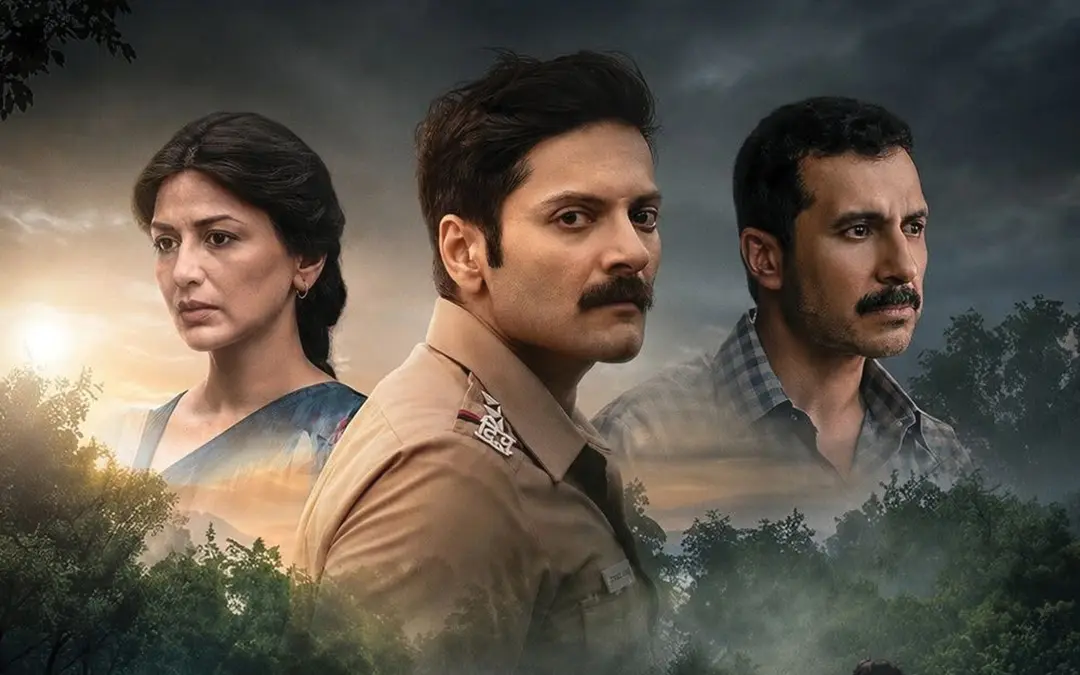
The true-crime genre on Indian OTT has arguably become oversaturated, frequently slipping into exploitative thrillers that treat real-world violence as mere entertainment fodder. With Raakh, creator-writers Anusha Nandakumar and Sandeep Saket alongside director Prosit Roy completely dismantle that formula. Revisiting the late-1970s tragedy that shook the nation’s capital to its very core, Raakh is less interested in the sensationalism of the manhunt and far more invested in the heavy, lingering weight of stolen futures and institutional apathy.
The Plot: A Rainy Evening that Changed Delhi Forever
The nightmare opens on a rainy evening in 1978 Delhi Cantonment. Sixteen-year-old Suman (Divya Sharma) and her fourteen-year-old brother Sahil (Vivaan Sharma) step out of their home to head toward an All India Radio station where Suman is scheduled to sing live on air. Their parents, Lt Col Ashok Arora (Aamir Bashir) and schoolteacher Mona Arora (Sonali Bendre), tune their radio set with pride—only to hear another child’s voice. Suman and Sahil never made it to the station.
The case drops onto the desk of rookie Sub-Inspector Jayprakash Jatav (Ali Fazal), a young Dalit officer battling deep systemic prejudice within his own department. As a relentless downpour washes away physical evidence, the investigation quickly transforms from a missing persons search into a devastating double-homicide tracking unit when the siblings’ bodies are discovered in the dense Ridge forest.
The narrative moves across dual parallel tracks: one charting Jayprakash’s exhausting, paper-heavy procedural hunt, and the other tracking the escalating journey of the perpetrators, Babu (Akash Makhija) and Rajjo (Ramandeep Yadav), who flee a botched ransom killing in Bombay to unleash chaos in the capital.
What Works: The Banality of Evil and the Poetry of Grief
- The Terrifying Newcomers: While the series features established stars, the absolute standouts are Akash Makhija and Ramandeep Yadav as the fictionalized versions of Ranga and Billa. They reject traditional, theatrical Bollywood villainy to portray violence with a cold, casual indifference that is deeply disturbing. Makhija is genuinely terrifying as the unhinged, remorseless Babu, while Yadav brilliantly charts Rajjo’s transformation from a petty, emasculated criminal into a brutal partner in crime.
- Sonali Bendre’s Career-Best Metamorphosis: Returning to the screen in a completely stripped-down, emotionally raw avatar, Sonali Bendre delivers a devastating portrayal of maternal grief. In one of the show’s most hauntingly poetic metaphors, her character, a mathematics teacher, attempts to teach rational and irrational numbers to her students in a daze, completely unable to process the irrational brutality of her reality.
- Flawless 1970s World-Building: Production designers recreate late-70s Delhi with exceptional, unflashy precision. The total absence of modern surveillance, mobile phones, or digital tracking forces the police investigation to rely entirely on witness statements, poor hand-drawn sketches, dusty paperwork, and raw instinct, generating an authentic, hard-earned level of tension.
- A Bold, Heartbreaking Finale: Director Prosit Roy takes a massive creative liberty in the final moments of the eighth episode, daring to visualize an alternate reality where the children survived to live out ordinary milestones. It functions as a massive emotional gut-punch that shifts the entire show from a crime procedural into a profound study of stolen time.
Where the Series Drags
The series is not entirely immune to the typical structural traps of the 8-episode streaming format.
- The Mid-Season Crawl: Around episodes 4 and 5, the pacing takes a noticeable hit. The narrative loops into repetitive patterns as the script spends a bit too much time on undercooked subplots—such as Jayprakash’s interactions with an investigative journalist love interest (Anshul Chauhan) whose character arc feels poorly written and adds very little value to the primary hunt.
- The Tyranny of Overexplanation: While the social commentary surrounding casteism, toxic masculinity, and the fallout of the Emergency is incredibly sharp, the writers occasionally fall into the trap of over-verbalizing their moral dilemmas through heavy dialogue rather than allowing the audience to sit with the visual discomfort.
The Verdict
Raakh is an incredibly mature, thoughtful, and deeply unsettling crime drama that lingers long after its final frame. It is not an easy or comfortable watch, but driven by a powerhouse performance from Ali Fazal and a devastating emotional core, it stands tall as a vital piece of television that forces us to look past statistics to remember the human lives lost underneath.
TL;DR / Key Facts
- The Release: Directed by Prosit Roy (Paatal Lok, Pari), the 8-episode true-crime procedural Raakh premiered on Amazon Prime Video on Friday, June 12, 2026.
- The Historical Anchor: The series is deeply inspired by the infamous 1978 Ranga-Billa case—the horrific kidnapping and murder of Delhi siblings Geeta and Sanjay Chopra that permanently altered India’s collective psyche around public safety.
- The Ensemble: Ali Fazal anchors the show as rookie Sub-Inspector Jayprakash Jatav, alongside a heavy-weight supporting cast including Sonali Bendre and Aamir Bashir as the devastated parents, and breathtakingly chilling performances from newcomers Akash Makhija and Ramandeep Yadav as the killers.
- Critical Verdict: Hailed as a haunting, atmosphere-drenched, and deeply unsettling slow-burn masterpiece. While critics point out a slightly repetitive middle act and a tendency to overexplain its social subtext, the show’s devastatingly poignant final act and stellar acting make it one of the finest Indian crime dramas in years.
Discover more empowering stories and insightful content like this on YOUxTalks, your go-to destination for inspiration and knowledge.
Follow YOUxTalks on Instagram: https://www.instagram.com/youxtalks